Trillion Trillion Tokens
Thought Leadership / 18 May 2026
Trillion Trillion
Tokens
Tokens may become the closest thing AI has to a planetary heartbeat. But right now, nobody is publicly counting the whole pulse.
Measure the work AI is doing for humanity.
On May 11, while looking through OpenRouter, I saw a number that stopped me for a few seconds: around 24 trillion tokens moving through one gateway on one day.
Then I started looking around. OpenRouter has already published a 100T-token usage study. Public OpenAI DevDay coverage has discussed API usage at billions of tokens per minute. Add frontier model APIs, cloud providers, enterprise copilots, consumer apps, local models, offline clusters, air-gapped systems, GPUs, ASICs, and private deployments, and the obvious question appears:
Not in one product. Not in one model. Not in one gateway. Across the planet.
We measure electricity. We measure oil. We measure internet traffic. We measure search volume, smartphone shipments, GPU revenue, cloud spend, and data-center power. But the closest unit of AI work itself, the token, still does not have a public global meter.
That feels strange to me.
A token is not a perfect measure of intelligence. It does not tell us whether the output was useful, true, creative, safe, or economically valuable. But it does tell us something important: a model was asked to think, read, write, translate, code, summarize, reason, classify, plan, or respond.
Tokens are not the whole story. But they are the pulse.
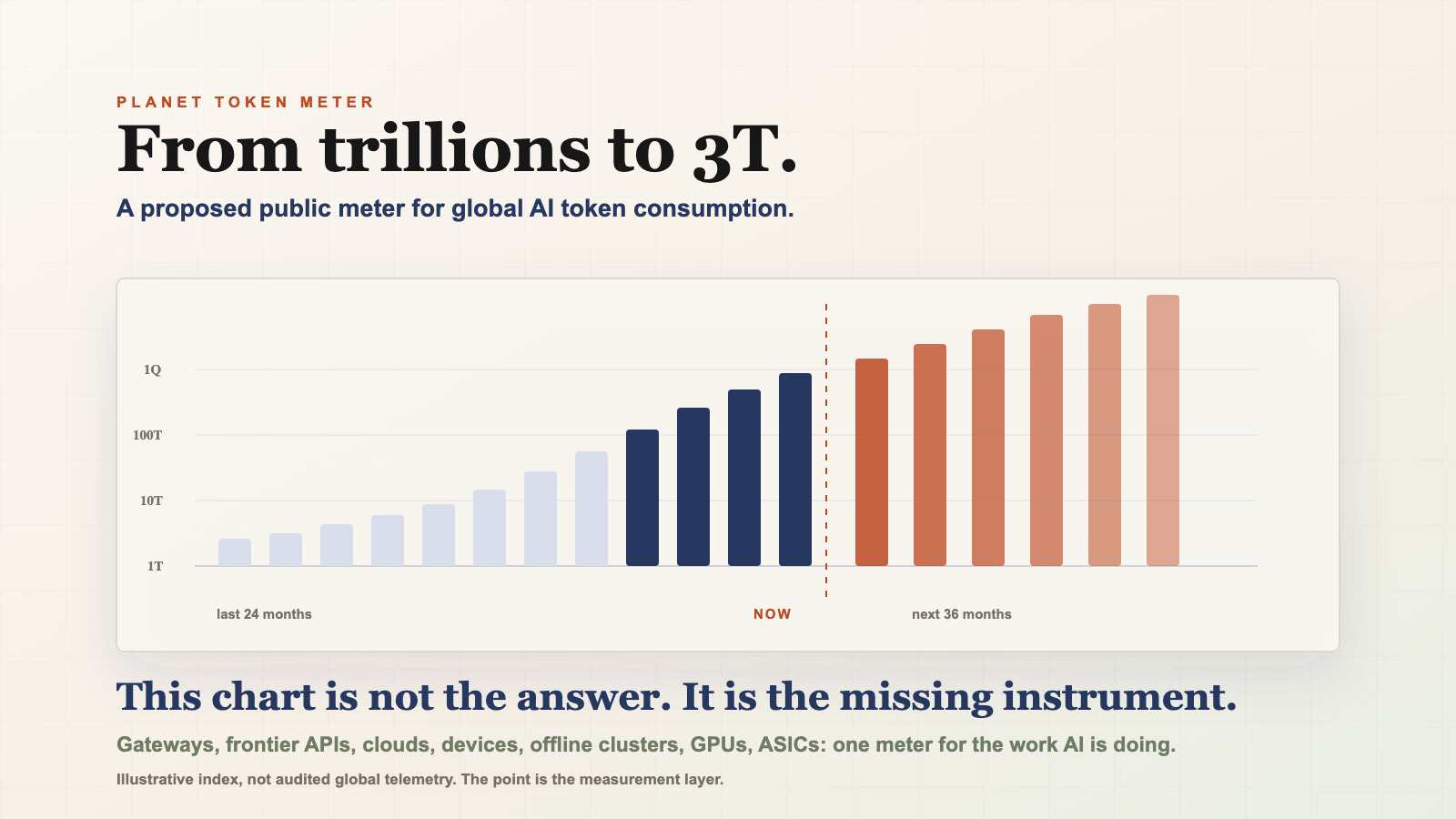
I do not mean a leaderboard for companies. I mean a public instrument: an approximate, transparent, constantly improving estimate of global token generation and consumption.
The first version will be imperfect. That is fine. GDP is imperfect. Internet traffic estimates are imperfect. Energy estimates are imperfect. But imperfect measurement is still better than no shared instrument at all.
The sources could start with public gateways like OpenRouter, then model builders, cloud providers, inference platforms, enterprise APIs, open-source hosting platforms, hardware-side estimates, and eventually private/offline signals where organizations choose to contribute anonymized data.
Some tokens are visible. Some are hidden. Some are generated inside closed clouds. Some are produced on laptops. Some are produced inside companies that will never report them. So the meter should be honest: measured, estimated, inferred, and unknown should be separate bands.
That separation matters. A serious meter should not pretend precision where precision does not exist.
This is the thought that stayed with me.
If tens of trillions of tokens in a day can already help people code, learn, sell, support customers, design products, run operations, write, research, and make decisions, what happens when humanity reaches trillion trillion tokens?
I am calling that horizon 3T: trillion trillion tokens.
Not because the number is clean. Not because we are close. But because it gives the imagination a place to stand.
At 3T, AI is no longer just software usage. It becomes a civilization-scale operating layer. Every factory, hospital, school, farm, lab, shop, office, court, city, device, and individual may have some kind of model doing work beside them.
The question is not only how many tokens we consume. The deeper question is: what kind of human progress do those tokens unlock?
Do they reduce waiting? Do they compress learning? Do they improve diagnosis? Do they help small companies act like large companies? Do they make governance clearer? Do they help a child learn in her own language? Do they help a technician fix a machine faster? Do they help a founder see the next decision?
If yes, then token consumption is not just infrastructure trivia. It is a measure of applied cognition moving through society.
The domain is decided: tokencounter.world. It is direct, practical, and honest. It does not try to sound like a product category before the instrument exists. It says what the first version must do: count the tokens.
The first version does not need to be grand. It can begin as a public page with methodology, source bands, confidence levels, and a simple live estimate: tokens per day, week, month, and year.
Then it can add trend lines. Then model family splits. Then geography where possible. Then inference source: gateway, direct API, cloud, device, private cluster. Then input/output split. Then cost estimates. Then energy estimates. Then impact proxies.
Eventually, the most interesting number may not be tokens consumed. It may be useful tokens consumed.
But first, we need the meter.
Because a world that is rapidly becoming AI-native should know how much AI work it is actually doing.
The 3T question is not a prediction. It is a challenge to build the instrument before the number becomes too large for intuition.
After trillion trillion, what is the next measurement? I do not know. Maybe the unit breaks. Maybe, like the cosmos, the scale becomes something we can point toward but never fully hold in the mind.
That is exactly why we should start counting now.
— Vikram Redlapalli