No One Brain. No One Model.
Thought Leadership / 24 May 2026
No One Brain.
No One Model.
AI will not contain all human knowledge. Its real job is to make more of it reachable, usable, and connected.
Knowledge map
No one brain. No one model.
AI does not contain all human knowledge. It makes more of it reachable.
The future is not one giant model.
It is humans, institutions, tools, and models making knowledge easier to use.
I was reading a report on a deceptively simple question: how much knowledge does humanity have?
The question looks innocent until you sit with it for a minute.
What exactly should we count? Books? Files? Scientific papers? Patents? Memories? Factory know-how? A surgeon’s hand? A grandmother’s recipe that was never written down? A technician’s instinct after twenty years beside the same machine?
Very quickly, the question stops being a storage problem and becomes a human problem.
Some of it is digital. Some of it is still on paper. Some of it is inside companies. Some of it is inside cultures. Some of it is in the body, not in language. Some of it is true only in a certain place, with a certain machine, with a certain customer, at a certain moment.
That is why “all human knowledge” is almost impossible to measure cleanly. Information can be counted in bytes. Knowledge cannot be counted so easily.
The best estimates measure technological information capacity: how much humanity can store, communicate, and compute. In 2007, one well-known study estimated that humanity could store roughly 295 exabytes of compressed information. Since then, the digital universe has moved into zettabytes, with annual data creation now measured in numbers so large they no longer feel intuitive.
But even those numbers miss something important.
A byte can store a sentence. It cannot tell you whether the sentence is true, whether it matters, whether anyone can use it, or whether it belongs beside another idea.
That is the first distinction I want to keep:
This matters deeply for AI.
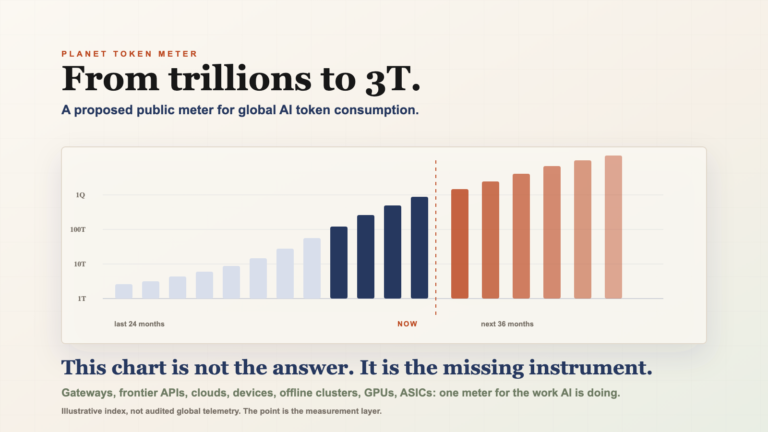
Large language models have already absorbed a massive share of public, digitized, text-based knowledge. Some estimates put the stock of high-quality public human text in the range of hundreds of trillions of tokens. The frontier models are already trained on trillions of tokens. In many fields and languages, the easy public text is no longer infinite.
But that does not mean AI has learned “all human knowledge.”
It has not seen every private database. It has not seen every factory workflow. It has not seen every hospital record, every local-language archive, every handwritten document, every paywalled corpus, every family business habit, every offline system, every embodied skill.
Most importantly, it has not lived.
There is a kind of knowledge that does not transfer cleanly into text. Riding a bike. Reading a room. Negotiating with a supplier you have known for fifteen years. Knowing when a motor sounds wrong. Knowing which employee needs pressure and which one needs confidence. Knowing the difference between a process that looks good on paper and a process that works on Monday morning.
AI can help describe these things. It can learn patterns around them. It can assist. But it does not fully become them.
So the interesting future is not one giant model that contains everything.
That layer will connect models, tools, databases, humans, sensors, workflows, institutions, and memory. It will not be perfect. It will not be complete. But it will make more of the world’s knowledge queryable, searchable, reusable, and actionable.
This is a different way to think about AI adoption.
The question is not: can one model know everything?
The better question is: how much of the knowledge around us can we finally use?
Because in most organizations, the problem is not that knowledge does not exist. It exists everywhere. It is in old emails, folders, SOPs, WhatsApp messages, ERP notes, service logs, design files, vendor calls, customer complaints, and the heads of people who have stayed long enough to remember why things are the way they are.
The tragedy is that most of this knowledge is not available at the moment of decision.
AI changes that.
Not by replacing human knowledge, but by reducing the distance between a question and the right memory.
A single human brain can hold only a tiny slice of humanity’s knowledge. A single AI model can only approximate a slice of what was available to train it. But a well-designed network of humans, models, and systems can make the useful slice much larger at the exact moment it is needed.
That is the real compounding effect.
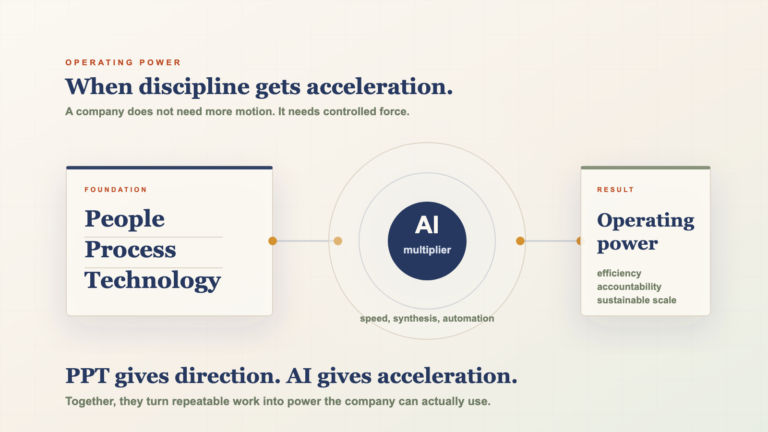
When knowledge moves from hidden to reachable, organizations become faster. When it moves from reachable to trusted, they become better. When it moves from trusted to embedded in daily work, they become scalable.
This is why AI is not only a technology story. It is a knowledge infrastructure story.
For the first time, humanity is building tools that can sit beside our accumulated memory and ask: what here is relevant now?
That question may be more important than whether the model knows everything.
Because no brain does. No model will.
But together, we may finally make much more of what we already know usable.
– Vikram Redlapalli