Three Kinds of Commitment
Thought Leadership / 10 May 2026
Three kinds of
commitment
Every organization is built by people who carry work differently. The mistake is pretending those patterns are the same.
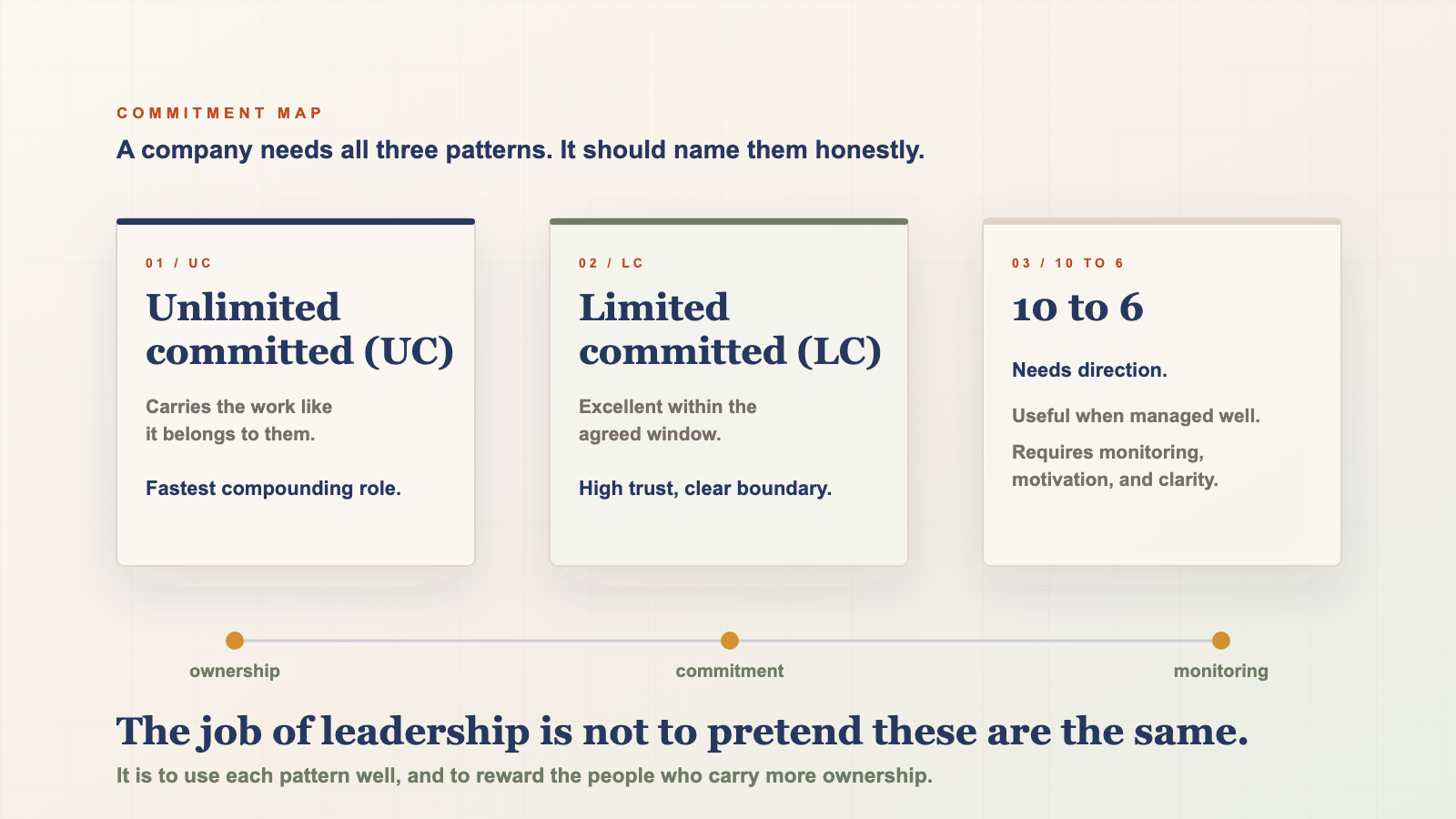
Reward the people who carry more ownership.
Over the years, I have come across three types of colleagues.
I do not mean this as a judgment of character. I mean it as an observation of work patterns. People carry work differently. Some carry it only when the system pushes them. Some carry it beautifully inside a clear boundary. Some carry it as if the company problem is their own problem.
A leader who does not see the difference will keep getting surprised. A leader who sees it clearly can build better teams.
These are the people who are almost 24x7x365 in their commitment. Not because someone forced them. Not because they are trying to impress anyone. They genuinely love what they are doing.
If there is something to learn, they are ready. If there is something to own, they do not resist. If something is burning on a Sunday morning or a holiday night, they are available. You can call them at 4 AM or 11 PM, and they will not first ask, “Is this office time?”
This is their greatness. They do not see work only as a transaction. They see it as a field where they can grow, contribute, solve, and become.
But UC should be understood carefully. It is not simply long hours. Long hours without ownership is just exhaustion. UC is ownership that does not switch off easily.
These colleagues are deeply committed within a clear working window. If office time is 10 AM to 6 PM, then inside that time they are 1000% present. They are serious. They deliver. They care about quality. They can be trusted.
After that window, because of personal commitments, family responsibilities, health, priorities, or any other valid reason, they may not be available. And that is also real life.
LC is not low commitment. It is bounded commitment. That distinction matters.
A good LC colleague can be extremely valuable. They bring rhythm, reliability, and professionalism. If the organization respects the boundary and designs work properly, they can produce excellent results without drama.
This is different from LC.
LC is excellent inside the boundary. The 10-to-6 pattern needs monitoring and motivation even inside the boundary. The person may be physically available, but the work does not move unless someone pushes, checks, follows up, reminds, and creates pressure.
Even these colleagues have a place in an organization. Some roles need structure more than initiative. Some people are early in their journey. Some people need the right manager, the right process, or the right environment before they become more dependable.
But the company should not confuse presence with commitment. Sitting from 10 to 6 is not the same as carrying responsibility from 10 to 6.
All three categories are needed to build an organization. This is important. A company cannot be built only with UCs. That would become intense, unstable, and eventually unfair. A company cannot be built only with LC either, especially when it is young and every system is still being created. And a company cannot avoid 10-to-6 colleagues entirely, because not every role needs the same level of ownership.
The real question is not which category is “good” and which category is “bad.” The real question is: what role can this person carry?
This is not only true in RDP. It is true everywhere.
The people who are willing to learn more, own more, respond faster, solve without being chased, and stay close to the work will grow faster. Not because the company is biased toward them, but because more ownership creates more trust. More trust creates more responsibility. More responsibility creates more growth.
That is how careers compound.
There is another pattern I have seen, especially in SMBs.
You meet some absolute rock stars whose formal education may be from tier-3, tier-4, or tier-5 colleges. On paper, the resume may not look elite. In reality, their understanding, hunger, commitment, and practical intelligence are beyond expectation.
These people are gold.
If you take care of them properly, they can stay with a company for a decade or more. They grow with the company. They understand its history, customers, mistakes, systems, people, and hidden knowledge. They become part of the organization’s memory.
A founder should never underestimate such people. Many SMBs are quietly built by these rock stars.
Then there is another type: Tier-1 talent. IIT, IIM, CA, and similar backgrounds. Many of them may not stay for ten years. Sometimes they stay for 12 to 15 months. But in that short time, the right person can add enormous value.
They bring sharp thinking, speed, frameworks, communication, and a different level of professional exposure. If they are committed, even for a short period, working with them can be a joy. They raise the quality of thinking in the room.
The mistake is to compare these two talent types as if one is always better.
The long-term rock star and the high-intensity Tier-1 sprinter can both change a company. One compounds through loyalty and deep operating memory. The other creates bursts of leverage, clarity, and speed. A good organization learns how to benefit from both.
That is the deeper point.
In a growing company, commitment is not a slogan. It is capacity. It decides how much ambiguity a person can hold, how much pressure they can absorb, how much responsibility they can carry without supervision, and how much trust the organization can place on them.
UC, LC, and 10-to-6 are not labels to print on people forever. People can move. A 10-to-6 person can become LC. An LC person can become UC for the right mission. A UC person can also burn out and need boundaries. These are patterns, not permanent identities.
But while building an organization, it helps to name what you are seeing.
Because once you name it, you can design around it.
You can give UC people ownership without abusing their availability. You can give LC people clear outcomes and respect their boundaries. You can give 10-to-6 people structure, monitoring, and roles where the cost of low ownership is not too high.
And above all, you can reward the people who carry more.
That is not unfair. That is how organizations grow.
— Vikram Redlapalli